For four months, my six-year-old daughter disappeared for ten minutes every day after school. She refused to tell me where she went. Then our elderly neighbor’s son showed up at my door. “Keep your daughter away from my mother’s house, or I’ll contact the police.” That afternoon, I followed her. She had a key. And our elderly neighbor was lying on the floor.
My name is Delphina Okafor, and I work as a home health aide in Akron, Ohio.
My six-year-old daughter, Jessamy, is in first grade. She has an adorable gap between her front teeth and loves collecting interesting little rocks.
We live in a modest house along a peaceful residential street. Our next-door neighbor is Mrs. Ulrike Brandt.
At eighty-four, Mrs. Brandt is a widow who lives by herself. She manages diabetes and mobility difficulties, relies on a walker, and once enjoyed sitting on her porch every afternoon, greeting children returning from school.
Earlier this year, however, she stopped spending time outdoors.
Her son, Dimitri, is in his fifties and lives on the other side of town. His visits are infrequent, perhaps once a month, and their conversations sometimes become tense enough for me to overhear.
“Mom, living by yourself isn’t practical anymore. You should consider selling this house and moving somewhere with professional care.”
“I’m not ready to leave my home, Dimitri.”
“Then I don’t know how I’m supposed to help you if something happens.”
In September, I began noticing an unusual change in Jessamy’s afternoon routine.
Whenever she stepped off the school bus, she would announce, “I’ll be right back, Mommy!” before hurrying away.
Approximately ten minutes later, she would return, smiling brightly and slightly breathless.
“Where have you been?”
“It’s a secret.”
“Jessamy.”
“I made a promise, Mommy. I can’t tell you.”
I assumed she had discovered a little hiding place somewhere or was searching for interesting stones. She was six, after all, and children that age often have little adventures they prefer keeping to themselves.
Before long, I started noticing that certain items were disappearing from our kitchen. Juice boxes, crackers, peanut butter, and occasionally a piece of fruit.
I convinced myself there was nothing unusual about it. Children love collecting snacks, and my grandmother used to discover forgotten granola bars tucked inside my jacket pockets.
Still, four months seemed like an unusually long time to keep a secret. Every afternoon at 3:40, when the school bus arrived and Jessamy hurried down its steps, I felt a growing sense of curiosity and concern.
One January afternoon, someone knocked firmly on my front door.
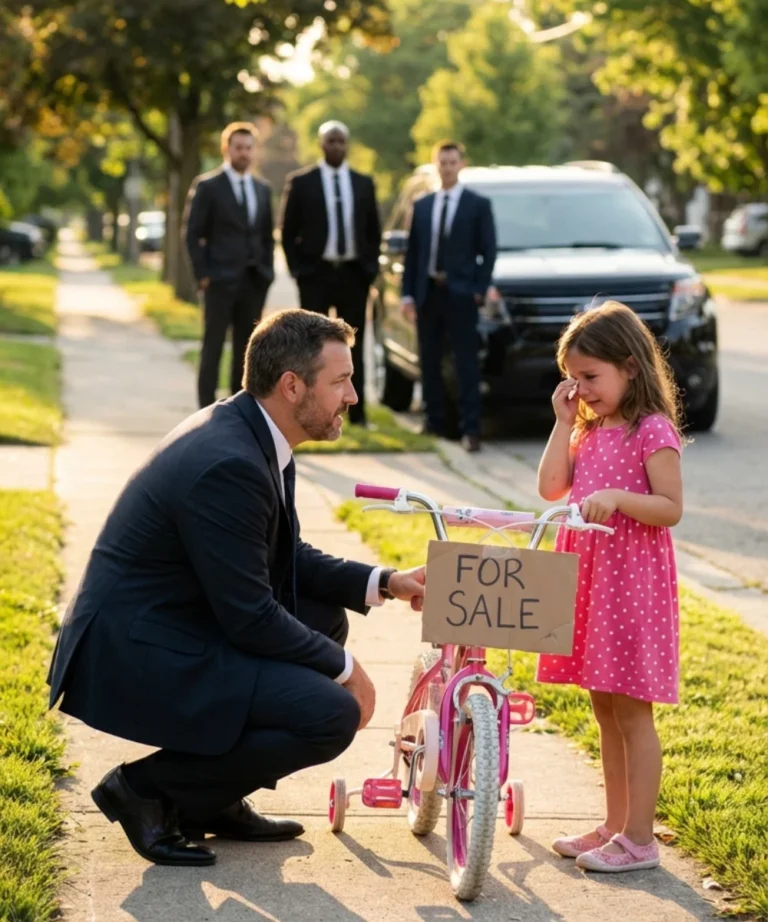
It was Dimitri, looking visibly frustrated and still dressed in his work jacket.
“Is that your daughter? The little girl who wears pigtails?”
“Yes. Her name is Jessamy.”
“I need you to keep her away from my mother’s house. Apparently, she’s been going inside, and I’ve found crackers and snack wrappers in the kitchen.”
“She’s been going inside? How?”
“I haven’t figured that out. My mother won’t explain it, and she’s been having some difficulties lately.”
He gestured impatiently before continuing.
“If your daughter keeps entering the house, I may have to contact the authorities. I don’t know why she’s there or whether she’s taking things.”
He walked away from my porch, leaving the storm door to close behind him.
I remained in the doorway, deeply unsettled by the conversation. My immediate reaction was to follow him and defend my daughter, but Jessamy was nearby, and experience had taught me that responding emotionally rarely improved difficult situations.
Rather than argue, I simply answered, “Okay.”
That afternoon, when the school bus arrived and Jessamy jumped down, cheerfully announcing, “I’ll be right back, Mommy!”, I waited several seconds before quietly following her.
She hurried across our lawn, her backpack bouncing behind her, before slipping through an opening in the hedge.
She was heading toward Mrs. Brandt’s back entrance.
Reaching into her jacket pocket, Jessamy produced a small key attached to a pink ribbon. She unlocked the door and quietly stepped inside.
I immediately felt concerned.
“Jessamy!”
I followed her through the back entrance.
The kitchen was unusually dim and chilly. The room felt as though it hadn’t been properly aired out for quite some time.
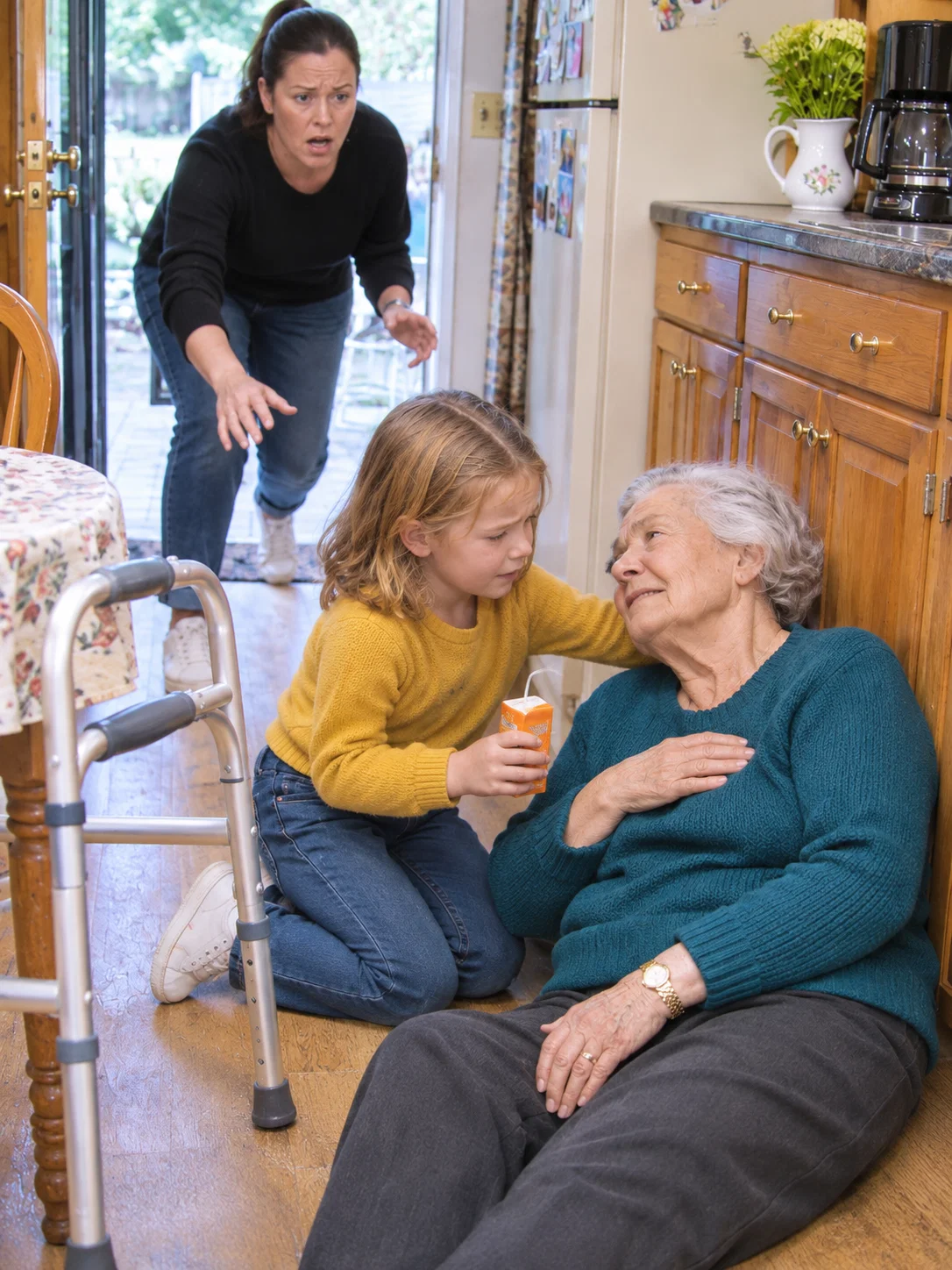
Jessamy was kneeling on the kitchen floor.
Beside her, between the refrigerator and the table, lay Mrs. Brandt, who appeared to be experiencing considerable difficulty getting up.
Her walker had fallen nearby, and a glass was lying on the floor. She looked extremely tired and seemed to need immediate assistance.
Jessamy was holding an apple juice box beside her.
“It’s your favorite juice, Mrs. Brandt. The apple one.”
When she looked toward me, her expression was filled with worry.
“Mommy, she fell. Yesterday, when I came over, she was already on the floor. I brought her juice because that’s what she told me helps when she feels shaky.”
“Yesterday?”
“She asked me not to tell anyone because she was worried her son would make her move away.”
Jessamy’s voice became unsteady as she continued.
“But she still can’t get up, Mommy. She’s been here since yesterday, and now she’s having trouble answering me.”
As a home health aide, I spend my working days supporting older adults. My professional experience immediately told me that Mrs. Brandt needed urgent medical attention.
I was concerned about her blood sugar, hydration, and the possibility of an !njury from her fall.
I knelt beside her and carefully assessed her condition. She appeared weak, and I knew that professional assistance was necessary without delay.
“Mrs. Brandt? Can you hear me? It’s Delphina, your neighbor.”
She opened her eyes slightly.
“Jessamy,” she murmured. “Such a good girl.”
I immediately contacted emergency services and explained the situation.
Following the dispatcher’s guidance, I stayed beside Mrs. Brandt, monitored her condition, and avoided moving her until trained medical professionals arrived.
Jessamy remained nearby, gently holding her hand.
“Everything’s going to be okay, Mrs. Brandt,” my daughter said reassuringly, repeating words she had probably heard from me before. “My mommy takes care of older people. That’s her job.”
I felt an overwhelming mixture of concern, affection, and uncertainty about everything my daughter had been managing alone.
For the moment, however, my priority was ensuring Mrs. Brandt received appropriate care while keeping Jessamy calm.
The paramedics arrived approximately eight minutes later. They assessed Mrs. Brandt, provided the necessary medical support, and prepared her for transportation to the hospital.
One of them, a tall man with a reassuring expression, noticed the juice boxes nearby.
“Who brought these over?”
“My daughter did.”
He glanced toward Jessamy before asking another question.
“Do you know how long she’s been here?”
“Since yesterday,” I replied. “That’s what my daughter told me.”
He paused thoughtfully before returning his attention to Mrs. Brandt.
At the hospital, medical evaluations confirmed several of my initial concerns. Mrs. Brandt had sustained a hip fracture, experienced significantly reduced blood sugar, and required treatment for dehydration.
She had apparently been unable to get up from her kitchen floor for nearly thirty hours.
“Your daughter clearly noticed that something wasn’t right and tried to help,” one of the paramedics explained when we spoke in the hallway. “It’s fortunate that you followed her today and contacted emergency services.”
I leaned against the corridor wall, trying to process everything that had happened.
My thoughts returned to those four months of disappearing crackers, peanut butter, and juice boxes that I had dismissed as ordinary childhood behavior. I realized how close I had come to reprimanding Jessamy for a secret rooted entirely in kindness and concern.
Mrs. Brandt underwent surgery that evening.
The following morning, after waking up and receiving further medical attention, she asked whether Jessamy could visit her.
My daughter sat carefully beside her hospital bed, still wearing her purple coat and gently swinging her feet.
“Are you upset because I told Mommy?” she asked.
Mrs. Brandt smiled softly and reached for Jessamy’s little hand, holding it affectionately between her own.
“Not at all, sweetheart. You made the right decision.”
Then she finally explained how their friendship had begun.
One afternoon in September, she had started feeling unwell while sitting on her front porch. Jessamy, walking home from the bus stop, noticed her discomfort and immediately approached to see whether she needed assistance.
Mrs. Brandt explained that she needed something from her refrigerator and asked Jessamy to bring her a juice box.
“I explained that juice sometimes helps when my blood sugar gets low,” she recalled with a gentle smile. “The following afternoon, she returned to see how I was feeling.”
“And then she came again the next day. Before I knew it, she was visiting every afternoon.”
“She brought crackers, peanut butter, and stories about her classroom. She told me about her rock collection and even which little boy kept eating classroom paste.”
“Ben Hutchins,” Jessamy added seriously. “He hasn’t stopped.”
Mrs. Brandt smiled and gently squeezed her hand.
“She was my most regular visitor. My son comes approximately once a month, and most of our conversations are about whether I should sell the house.”
Eventually, Mrs. Brandt had given Jessamy a spare key for afternoons when her mobility difficulties made answering the back door particularly challenging.
“I asked her to keep our visits private,” Mrs. Brandt admitted quietly, her eyes becoming moist. “I was worried about what might happen if Dimitri realized how much assistance I needed.”
“I thought he would insist that I move somewhere else. I’m sorry I placed that responsibility on such a young child.”
“I understand now that it wasn’t appropriate. I was so concerned about losing my independence that I allowed a little girl to share worries that should have belonged to adults.”
I reached over and held her other hand.
“You don’t owe me an apology. What matters now is finding a better way forward.”
“I’ll try my best.”
That evening, Dimitri arrived at the hospital.
Still wearing his work jacket and carrying his car keys, he entered the room and suddenly stopped. When he noticed Jessamy sitting beside his mother, his expression changed.
“Why is she here?”
A nurse approached and calmly addressed him.
“Sir, this little girl noticed that your mother needed assistance. She had been unable to get up for approximately thirty hours after experiencing a fall, and the child’s mother contacted emergency services.”
Dimitri’s expression immediately shifted from frustration to disbelief.
“Thirty hours?”
“Could you tell us when you last checked on your mother, sir?”
He started to respond but seemed unable to find the appropriate words.
His gaze moved from his mother, resting quietly against her hospital pillow, to the little girl with pigtails and a gap between her front teeth who had been visiting her every afternoon.
“I didn’t realize,” he finally admitted, his voice becoming quieter. “I thought she simply didn’t want to listen to me. I genuinely believed she was managing.”
“You never really asked how I was doing,” his mother replied gently. Her words carried no bitterness, only the weight of an honest observation.
Dimitri lowered himself into the chair beside the window. Several moments passed before he finally turned toward Jessamy.
“I said I might call the police because of you.”
“I remember,” she answered. “You were speaking really loudly.”
I nearly smiled at her straightforward response. Instead, I rested my hand gently on her shoulder.
“Jessamy, would you like to visit the vending machine with the nurse and choose a snack?”
After she left the room, Dimitri rested his face in his hands.
“I suggested she might be taking things,” he admitted quietly. “I made assumptions about both of you.”
“I was so focused on the house, the finances, and everything else that I never stopped to consider why a little girl would be spending time in my mother’s kitchen.”
“That’s right,” I answered. “You didn’t.”
I wasn’t prepared to dismiss his earlier behavior, but I also had no intention of making the situation more uncomfortable. He already seemed to understand the seriousness of his misunderstanding.
“I don’t know where to begin making things right.”
“You don’t have to solve everything immediately,” I told him. “Begin by being present.”
Mrs. Brandt spent the following six weeks at a rehabilitation center, receiving professional support as she recovered from her hip surgery. I visited three times each week, and Jessamy often accompanied me, carrying colorful drawings and a slightly uneven rock she had painted purple.
“This is for your windowsill,” she explained proudly. “It’ll remind you that you’re coming home.”
Mrs. Brandt kept the little painted stone on her bedside tray throughout her recovery.
During those weeks, I focused on what I knew best. Together with her physician and social worker, I helped establish a practical support plan for her eventual return home.
We arranged a medical alert device, professional home nursing visits three days a week, bathroom safety rails, and additional support near the back entrance.
There would also be a medication organizer, regular telephone check-ins, and one personal commitment from me: I would stop by every afternoon after finishing work.
“I couldn’t possibly afford to pay you for all that,” she said.
“I’m not expecting payment.”
“But caring for people is your profession.”
“My profession is what I do during my eight-hour shifts. Checking on someone next door is simply part of being a good neighbor.”
She turned her head slightly, blinking away tears.
“It’s been a very long time since anyone treated me that way.”
“Then it’s about time someone did.”
Dimitri supported every part of the arrangement. I suspected he was still reflecting on everything that had happened, and he began visiting the rehabilitation center every Saturday.
He would sit somewhat awkwardly in the visitor’s chair while his mother completed her recommended exercises.
During his first few visits, he barely spoke.
By the third week, however, he was bringing newspapers and reading crossword clues aloud.
By the fifth week, he had learned precisely how his mother preferred her tea, accompanied by a small slice of lemon.
One Saturday afternoon, I discovered him standing in the hallway outside her room, quietly studying a bulletin board.
“I was planning to sell her house,” he admitted without looking toward me. “I’d already contacted a real estate agent, and I kept convincing myself it was the best decision for her.”
“Did you truly believe that?”
He remained silent for several seconds.
“Partly,” he finally acknowledged. “But I was also overwhelmed and worried.”
“It seemed easier to arrange for her to move than to figure out how I could help her remain where she wanted to be.”
“I appreciate your honesty.”
“I’m working on it.”
He rubbed the back of his neck thoughtfully.
“I don’t think I’ve been completely honest with myself about any of this for quite some time.”
“Recognizing that is a meaningful beginning.”
He finally turned toward me, meeting my eyes directly.
“I owe you a sincere apology, Delphina. I came to your house, spoke disrespectfully, and made unfair assumptions about your daughter. Neither of you deserved that.”
“No,” I agreed. “We didn’t.”
“I’m truly sorry.”
“Thank you.”
I allowed a comfortable silence to settle between us before sharing something that I knew might reassure him.
“Jessamy has already forgiven you. Yesterday evening, she told me that you seemed sad rather than unkind.”
A faint smile appeared on his face.
“She really said that?”
“She’s six. Sometimes children notice things adults overlook.”
Mrs. Brandt returned home on a beautiful spring morning, just as the cherry tree in her front garden was beginning to blossom. Dimitri personally helped her up the newly installed accessibility ramp.
Jessamy stood beside the entrance, proudly holding a handmade sign displaying WELCOME HOME in uneven purple lettering, complete with an additional E.
“Welcome Homee?” Mrs. Brandt read aloud, smiling with delight.
“It’s French,” Jessamy confidently explained.
“Well, of course it is.”
Inside, the house smelled pleasantly of lemon cleaning products and freshly baked bread. I had organized a few neighbors to help prepare the rooms and fill the refrigerator before her arrival.
Dimitri had repaired a loose handrail and replaced several light bulbs. On the kitchen counter sat a cheerful bouquet of tulips alongside an unopened package of apple juice boxes.
Mrs. Brandt noticed the juice and laughed warmly, becoming visibly emotional.
“Every time I see an apple juice box, I’ll remember you,” she told my daughter.
“That’s exactly what it’s for,” Jessamy replied.
There was one important change I wanted to make that afternoon, and I approached it gently. I asked Mrs. Brandt to return the spare key attached to the pink ribbon.
Jessamy immediately looked disappointed.
“This isn’t a punishment, sweetheart,” I explained, crouching so we were at eye level. “Adults need to manage things like keys and emergencies.”
“When someone needs help, a six-year-old shouldn’t feel responsible for handling everything by herself.”
“But I’m the one who found her.”
“You did, and your kindness made a wonderful difference. But if you ever notice something worrying again, I need you to tell me immediately, even if someone asked you to keep it private.”
She thought carefully about what I had said.
“Even when it’s supposed to be a secret?”
“Especially then. When a secret involves someone’s safety, it’s important to share it with a trusted grown-up.”
She nodded slowly.
“Okay, Mommy.”
“That’s my girl.”
Mrs. Brandt gently reached out and touched my arm.
“She can still come over whenever she wants, can’t she?”
“Of course,” I assured her. “She just needs to knock on the door first.”
“Three knocks,” Jessamy immediately announced. “That’s our special signal.”
“Three knocks it is,” Mrs. Brandt agreed happily.
Dimitri offered me another spare key, this one attached to a small blue tag, and asked whether I would be comfortable keeping it.
“Just in case she needs assistance and I’m unable to get here quickly,” he explained. “I want to make sure she always has someone nearby.”
“Of course.”
“I’m also rearranging my work schedule. My manager agreed that I could work remotely from her house two days every week.”
He gave a brief, slightly em.bar.ras.sed laugh.
“Apparently, sometimes all you have to do is ask.”
“Apparently so,” I replied.
By summertime, the neighboring house had regained much of its former charm. A beautiful pot of geraniums decorated the porch, and the windows were frequently open to welcome the fresh afternoon air.
Mrs. Brandt was once again spending time outside, a comfortable blanket resting across her knees as she waved cheerfully to children returning from school.
When autumn arrived, Jessamy began second grade.
On her first afternoon back, the school bus appeared at precisely 3:40, just as it always had. The doors opened, and my daughter hurried down the steps, her pigtails bouncing and another interesting little rock tucked safely inside her pocket.
“I’ll be right back, Mommy!”
“Go ahead,” I answered with a smile. “Give Mrs. Brandt my regards.”
She hurried across our lawn and slipped through the familiar opening in the hedge. I watched her disappear around the corner, her backpack bouncing beneath the gentle afternoon sunshine.
Three cheerful, familiar knocks sounded against Mrs. Brandt’s back door.
From inside came a warm, confident voice that sounded stronger than it had in many months.
“Come inside, my little angel!”
These days, they spend their afternoons together at the kitchen table, sharing a plate of crackers and two little glasses of apple juice. Sometimes Dimitri joins them, still occasionally looking a little awkward as he learns to appreciate a connection he had nearly overlooked.
Mrs. Brandt often says those afternoons are the happiest part of her day.
Jessamy insists that it’s their little secret.
But it isn’t a secret anymore.
And I’ve gradually learned that some secrets become something much more meaningful when they’re shared with the right people at the appropriate moment.
Sometimes, the youngest person in the room is the one who notices the things everyone else has been too occupied to see.