I Returned Home From a Doctor’s Appointment and Found a Note From My Son on the Refrigerator: “Mom, my wife and I flew to Miami. Don’t call us. We need privacy.”
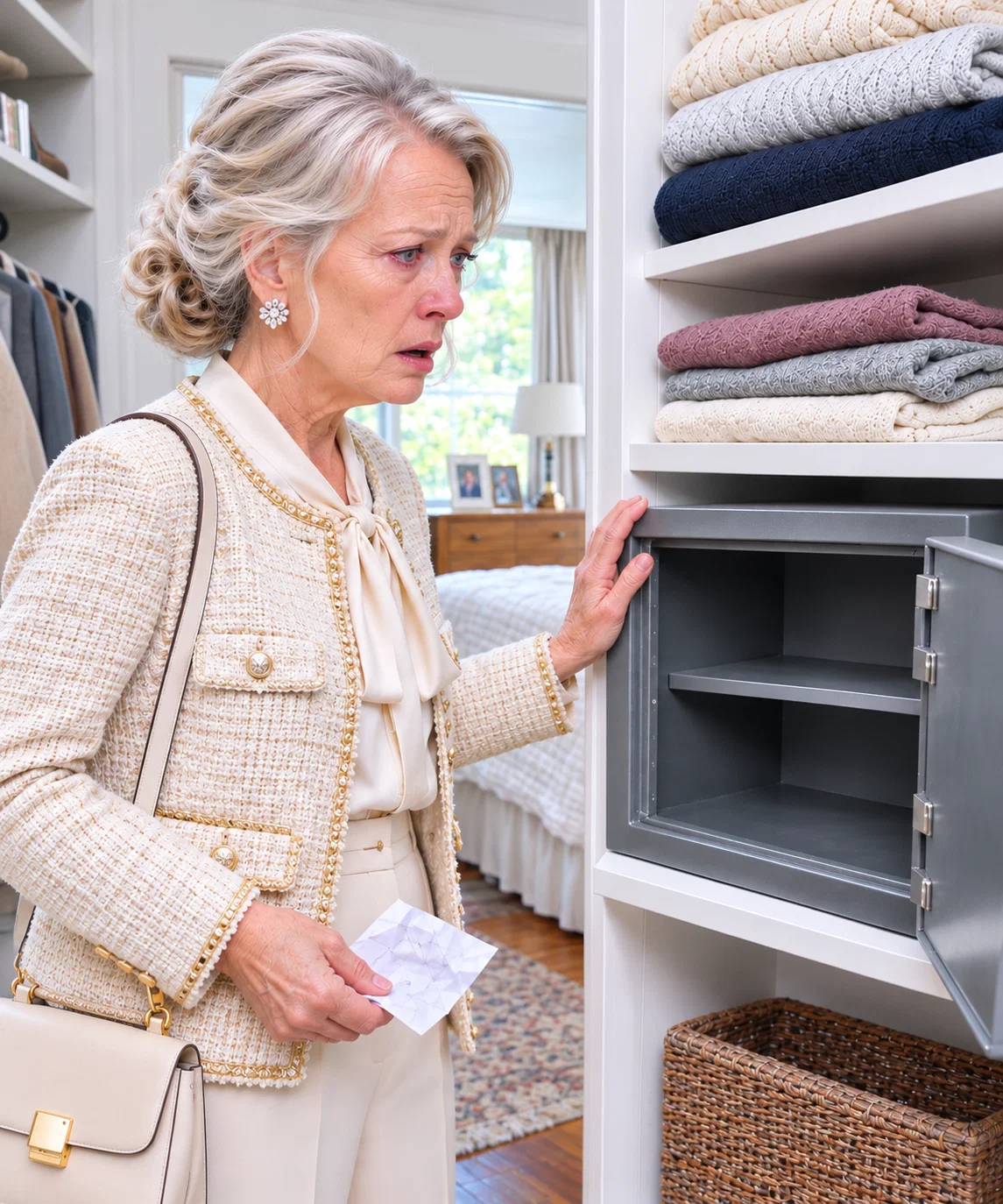
Returning from a medical appointment, I discovered a message stuck to the refrigerator. Mom, my wife and I are traveling to Miami. Do not call. We want privacy. Signed, Caleb. My son. My stomach sank. I hurried into my bedroom, through the walk-in closet, and toward the safe containing a decade of savings. My fingers shook as I entered the combination. Inside was nothing. The entire $200,000 I had accumulated through double shifts as a registered nurse had vanished. Years of sacrifices and sleepless nights had been stolen by my son and Bianca, the woman who had promised to love me like her own mother.
They had departed for Miami, leaving a heartless note behind and taking my life’s work in cash. They expected me to weep in solitude, helplessly telephone them, and plead for answers while they spent my money on tropical beaches. They had severely misjudged me. Neither realized that for six months I had been preparing for this situation, organizing something they would never anticipate.
Throughout those months, I had impersonated the frail, muddled elderly woman they wanted me to become. Behind that disguise, however, my mind remained sharp. My tears were deliberate, my confusion an act. While they regarded me as incapable of remembering where my keys were, I was arranging their downfall. Now they were flying toward Miami, convinced that their scheme had succeeded.
They knew nothing about the reception awaiting them at the airport, which I had arranged with the precision of a surgeon. Stealing from the wrong person can carry a devastating price. But the beginning of this story wasn’t an empty safe or a refrigerator note. It was three years earlier, when my husband died, leaving me a mortgage-free apartment, a reasonable pension, and $200,000 in savings. Overnight, I became an ideal target for predators within my family.
I’m Margaret, sixty-seven, and I spent forty-two years nursing at General Hospital. I witnessed births, deaths, families torn apart by inheritance disputes, and others united by sincere affection. I believed I understood people and that my son was different. Five years earlier, when Caleb introduced Bianca, my instincts warned me. At thirty-three, eight years his junior, she smiled excessively, embraced me mechanically, and offered compliments that lacked sincerity.
I kept quiet because criticizing a son’s partner makes his mother the villain. Caleb appeared happy, and I wanted him to find companionship. Their wedding was intimate, with few of Bianca’s relatives present. “We are estranged,” she explained tearfully. I now recognize that excuse as a warning. My husband distrusted her too. One evening he remarked, “that woman has shark eyes. She smiles, but she feels nothing.” I silenced him, asking him not to spoil Caleb’s happiness.
His warning now torments me. For two years, life seemed ordinary: periodic visits, dinners, telephone conversations. Bianca performed the affectionate daughter-in-law routine, buying hideously colored scarves, perfumes that triggered allergies, and books I’d never read. I thanked her for these indifferent gestures, hoping to remain involved in their lives. My husband’s death changed everything.
A heart attack took him in his sleep. We’d gone to bed normally; by morning, the body I embraced was cold.
Amid the funeral’s tears and meaningless condolences, Caleb stayed close, comforting me. At least, that’s what I thought. He was actually assessing how soon my grief could become profitable. Two months later, he arrived one Saturday morning with coffee and donuts, my favorite breakfast.
“Mom, we need to talk about your financial security.” His concern sounded convincing. “You have to be careful. There are a lot of bad people who take advantage of widows, scammers, salespeople, fake advisors.” The irony sickens me now. He persuaded me to grant him emergency access to my bank account. “Mom, to help you if you need something and cannot go to the bank. You know that sometimes you have trouble remembering things.” It was his first suggestion that my mind was failing.
I was sixty-four and perfectly lucid, yet his insinuation made me doubt myself. Foolishly, I signed, granting him the access that would enable my destruction. The requests seemed harmless. Five thousand dollars for car repairs. “Mom, it broke down on the highway. We need the money today.” I transferred it immediately. Three weeks afterward, Bianca supposedly needed ten thousand for a business venture. “It is a unique opportunity. We will pay you back in 6 months.” Nothing was repaid.
Then came fifteen thousand for unforeseen medical bills, twenty thousand for kitchen renovations, and eight thousand for a professional course Caleb needed. I kept giving, convinced I was supporting his future. Whenever I hesitated, he’d embrace me and murmur, “you are the best mother in the world. I do not know what I would do without you.” Today those words feel like blades. Two years ago, Bianca visited my apartment alone, an unusual occurrence.
Sitting beside me, she clasped my hands anxiously. “Mom, Caleb and I are very worried about you. Living alone at your age is not safe. What happens if you fall? What happens if you get sick and no one is there to help you?” She presented her proposal as loving concern. “Come live with us. We have space. We can take care of you. We will be a real family.” Her eyes filled with expertly manufactured tears.
Loneliness convinced me to accept. I missed companionship and wanted to believe Caleb genuinely wished to share his home. After selling some furniture, I arrived with two suitcases and dreams of spending my remaining years surrounded by family. For a month, everything seemed wonderful. Bianca prepared my favorite dishes, Caleb drove me to appointments and supermarkets, and we watched films together at night. Following my husband’s death, I’d finally found somewhere I belonged.
Once I felt secure, their disguises slipped. “Margaret, can you wash these clothes? I just arrived so tired.” I obliged without complaint. The following day: “Margaret, prepare dinner for 7:00. We are going to arrive hungry.” Then: “Margaret, clean the bathroom. It is filthy.” Gradually, my position shifted from mother-in-law to unpaid housekeeper. Even worse than the endless chores was the degrading way they addressed me.
Caleb spoke as though I were a toddler. “Mom, did you take your pills?” His patronizing voice resembled the one used with dementia patients. “Mom, do not go out alone. You might get lost.” I’d navigated this city for forty years. “Mom, better not drive anymore. You are too old. You could cause an accident.” Daily, they stripped away my independence until I became little more than a breathing, cooking, cleaning object without opinions.
Bianca dismissed any suggestions I offered. “Oh, mom, it is not done like that anymore. Times have changed.” When I requested visits with friends, Caleb found reasons to refuse. “I cannot take you today. Mom, better stay home. It is too hot for you to be walking in the street.” People supposedly devoted to me were isolating me inside their house. Whenever I withdrew money, Bianca conveniently produced another crisis.
“Mom, the washing machine broke down. We need $3,000 urgently.” Then, “Margaret, the car needs new tires. That is 4,000.” Or, “Mom, we have to pay the house insurance. That is 6,000.” Every expense became mine because they housed and fed me, despite receiving over $80,000 within two years and benefiting from my unpaid labor. They acted as if tolerating my existence were charity. I continued behaving as though nothing was wrong.
I smiled at Caleb’s forehead kisses and thanked them for dinner leftovers, maintaining the foolish grandmother persona. Some survival instinct urged me to observe quietly until the proper opportunity arrived. That opportunity came six months ago on a Tuesday afternoon. I’d supposedly been napping in my bedroom. They assumed elderly people needed three hours of sleep every afternoon. In reality, those pretend naps gave me temporary relief from their insults and demands.
That afternoon, an unusually urgent, excited conversation drifted from the living room.
This wasn’t ordinary discussion about dinner or the weather. Silently, I rose, cracked open the door, and listened. “When she dies, this apartment is ours, plus the savings she still has left in the bank.” Bianca sounded as delighted as a lottery winner. “Yes, but she is taking a long time to die. My mom has the health of an ox.” Those casual words belonged to Caleb.
My baby, whom I’d breastfed, nursed through pneumonia at five, and comforted after nightmares, was discussing my death as casually as requesting salt. My world seemed to collapse, yet I neither cried nor confronted them. Something inside me changed. The nurse familiar with humanity’s ugliest behavior took over. Emotional reactions would accomplish nothing. I remained motionless, committing their conversation to memory as carefully as an anatomy lesson.
“We can speed things up.” Bianca sounded almost gleeful. “A nursing home would finish her off in months. I have investigated. They put them in there, fill them with medications, and in 6 months they are dead or so gone they do not even recognize their own name.” Caleb hesitated. “I do not know. It gives me the creeps. She is my mother.” His tiny flicker of conscience vanished when Bianca spoke again.
“Your mother is an investment that already gave everything she could give. We already got more than $100,000 out of her, but she still has another $100,000 in that account she does not touch. And the apartment is easily worth $250,000. We are talking about more than $300,000, Caleb. $300,000 that are ours as soon as she disappears.” I waited desperately for Caleb to defend me, hoping some trace of the boy I’d raised remained. Instead, he answered, “You are right.”
“You are right. She is already too much of a nuisance. Besides, with that money we can go to Miami like we want. Trey is waiting for our share to open the restaurant. This is our opportunity to start over, to be something more than a pair of failures supported by my mom.” Trey was unfamiliar, another participant waiting in Miami to finance a business with my stolen savings. Anger burned through me, but I breathed deeply, using the techniques I’d taught mothers in labor.
“The plan is perfect.” Bianca’s voice carried vicious satisfaction. “We drain what is left in the bank little by little. She does not even notice. We have already gotten large amounts out of her before, and she never says anything. Afterward, we tell her we need money urgently for a medical emergency of yours. We take everything out. In a week, we travel to Miami, open the restaurant with tray, and when we come back, we put her in the cheapest nursing home we find.”
“And if she asks about the money?” Caleb feared discovery, not the harm they intended. Bianca replied, “We tell her we lost it in investments, or better, that it was stolen, that someone cloned her card. She is already half senile. She is not going to understand. And even if she understands, what is she going to do? Report her own son? Please. That woman has forgiven us for everything always. She is a fool who lives to please me.”
After sacrificing everything for Caleb’s education, opportunities, and happiness, I was merely a fool to his wife. He didn’t defend me; he laughed at the prospect of stealing from me and abandoning me. “Then it is decided. In two weeks maximum, we have all the money. We buy the tickets to Miami. We tell her we are going on a short vacation. When we return, nursing home and us finally free of this burden.” His relief was unmistakable. His own mother had become an obstacle.
The $200,000 I’d earned through hard work was their reward for putting up with me. Quietly, I returned to bed and studied my wrinkled hands. They had changed Caleb’s diapers, prepared homemade baby food, sewn clothing when money was scarce, worked double shifts to finance college, applauded his graduation, and maintained his house for two years. That afternoon, I decided I wouldn’t end up weeping in a nursing home while he enjoyed my savings elsewhere.
They wouldn’t witness my collapse. I would outplay them. Over forty-two years in healthcare, I’d encountered inheritance disputes, children poisoning parents, wives forging paperwork, medical fraud, identity theft, and scams against seniors. Experience had taught me that retaliation demanded composure and calculation. Betrayal had presented an opportunity to become their nightmare. That night I lay awake, examining everything I’d overheard. People routinely underestimate the elderly, assuming we’re confused, sluggish, and useless. Their prejudice would become my advantage.
The following morning, I joined them for breakfast as usual. Caleb checked his phone over coffee while Bianca scrambled eggs. She glanced sideways as I entered. “Good morning, mom. Did you sleep well?” I knew what hid behind that sugary voice. “Yes, dear. Very well.” I smiled with convincing innocence. During breakfast, Caleb asked whether I’d taken my blood pressure medication. I said yes, although I didn’t suffer from hypertension. That was another invention designed to portray me as sickly.
After kissing them goodbye, I returned upstairs and began transforming my situation. In my closet was an old box containing records from my hospital career, including contact details for colleagues, physicians, social workers, and attorneys I’d encountered. Some owed me favors; others were simply trustworthy. Among them was Arthur, a lawyer I’d helped keep alive after a traffic accident ten years earlier, stabilizing him until an ambulance arrived. He’d promised to help whenever I needed him.
Using the old mobile phone Caleb assumed I couldn’t operate, I contacted Arthur. “Arthur? It is Margaret, the nurse from General Hospital. Yes, the one who treated you years ago. I need your help. It is urgent and delicate.” He paused. “Are you in danger?” I explained, “Not physically, but they are trying to rob me. My own son. I need to protect my assets before it is too late.” Without unnecessary questioning, he arranged an appointment two days later. I explained that I’d come alone to avoid suspicion.
I’d taken the first step, but much remained to be done. Downstairs, Bianca was watching television. Wearing my most innocent expression, I sat beside her. “Dear, I was thinking, I want to put my apartment in your name. Well, in Caleb’s name. So when I die, there are no legal problems.” She nearly fell off the couch, her eyes brightening with greed. “Seriously, mom? Oh, you do not have to do that. We are going to take care of you always.”
“No, no. I insist. You have been so good to me. It is the least I can do.” Deception came surprisingly easily. “Let me talk to Caleb. He can help you with the papers. This is very generous of you.” She embraced me triumphantly. I hugged her back, mentally noting how eagerly she’d seized the opportunity. My proposal had intensified the greed that was already driving them.
Over dinner, Caleb mentioned the apartment. “Mom, Bianca told me about the apartment. Are you sure? We do not want you to feel pressure.” His performance was convincing. “I am sure, son. I want it to be yours. You are everything I have.” Saying those words hurt, but I sounded sincere. “Then tomorrow we will go to a lawyer. We will make everything legal and fast.” They believed victory was close. Instead, I was collecting evidence of their deception.
The following day, while Caleb worked and Bianca met friends, I took a taxi downtown to Arthur’s office in an elegant older building.
He welcomed me warmly. “Margaret, tell me everything.” I described the overheard conversation, their intended theft, the nursing home, Miami, and Trey. He listened closely before responding, “This is grave. Fraud, financial abuse of an elderly person, possible kidnapping attempt if they put you in a facility against your will. We can act, but we need solid proof. We need more than your word against theirs.”
“I know. That is why I need your help to get that proof.” Opening a notebook, Arthur outlined a plan to protect my assets through an irrevocable trust, document two years of financial transactions, and obtain evidence of their admissions. He also proposed involving a private investigator to establish Trey’s identity and examine Bianca’s background. I asked how long everything would take. “3 to 6 months. We need solid evidence. Let them bury themselves with their own words and actions. Meanwhile, you keep acting normal. In fact, act more vulnerable, more confused. Make them believe you are losing your mind. That will make them careless.”
For the first time in two years, I left somewhere feeling empowered. Arthur referred me to Mike, an efficient, discreet private investigator. I contacted him from a public telephone, and we met the following day at a distant coffee shop. Serious and professional, he appeared approximately fifty. As I explained everything, he asked about Bianca’s maiden name and previous employment. I couldn’t answer either question. Astonishingly, I knew virtually nothing about the woman who’d taken my money and consumed two years of my life.
“Do not worry. I am going to investigate her thoroughly. If she has a record, I am going to find it. I am also going to verify the Miami thing and this Trey character.” Two days afterward, Mike visited disguised as an internet technician and installed concealed recording equipment. Caleb and Bianca suspected nothing. He supplied me with a tiny voice recorder as well. From then onward, their conversations and my encounters with them could be documented.
Every day became a performance. I walked more slowly, deliberately misplaced things, asked where my glasses were while holding them, and forgot whether I’d eaten immediately after lunch. Caleb and Bianca traded pleased expressions. They believed my condition was worsening. A week later, Mike contacted me. “We need to meet. I found something.” At our usual coffee shop, he produced a folder containing disturbing discoveries.
“Your daughter-in-law’s name is Bianca Dominguez, but that is not her first marriage. She was married before, eight years ago, to a man named Armando Salazar, a widower, 65 years old. He died two years after getting married, apparently of natural causes.” I froze at the word apparently. Mike explained that Armando’s relatives suspected she’d influenced him to alter his will shortly before dying. Their complaint had gone nowhere without proof. Bianca inherited his house, savings, and life insurance, worth over $300,000. His relatives received nothing.
“My god.” I could scarcely speak. Mike continued explaining that Bianca had squandered the fortune within three years on traveling, clothing, and an unsuccessful boutique. By the time she met Caleb, she was penniless and searching for another target. A widow possessing property and savings had been conveniently available. Mike produced additional documents and photographs from social media. Trey Reyes, a self-described Miami entrepreneur, had served two years in prison for real estate fraud and been released five years earlier.
More disturbing was Trey’s relationship with Bianca. They’d known each other for a decade and dated before her marriage to Armando. An old beach photograph showed a younger Bianca embracing a dark-haired man. Mike believed they were accomplices with an established pattern: Bianca married older men or their children, acquired their confidence, extracted their assets, and disappeared to Miami, where Trey waited. The proposed restaurant might be a front for laundering money.
Nausea overwhelmed me. This wasn’t simply domestic greed; it resembled organized financial crime. Perhaps Caleb was too blinded to recognize his own exploitation, or perhaps he knowingly participated for the money. “What about my son? Does he know all this?” Mike doubted it. His investigation revealed $80,000 in gambling debts owed to online casinos and loan sharks. Bianca knew about them and was likely exploiting Caleb’s desperation, promising a new beginning in Miami if he robbed me.
Eighty thousand dollars. My son had concealed enormous debts while repeatedly requesting money for invented emergencies and financing his gambling addiction. His affectionate gestures had hidden his lies. Mike produced another document: Caleb and Bianca had purchased one-way tickets to Miami, departing in two weeks. “Margaret, they are going to take your money and disappear.” Rage surged through me, no longer helpless but controlled. I wanted them confident enough to expose themselves. Mike smiled, promising to contact someone in the Miami police department and arrange for authorities to meet them.
I returned home with clarity. Their behavior made sense. I had control, not them. Over the following weeks, I intensified my performance, occasionally calling Caleb Dad, asking what day it was, and deliberately leaving the stove on. Caleb looked sympathetic; Bianca barely concealed her delight. During dinner one evening, Caleb broached the subject of finances.
“Mom, we need to talk about something important. Bianca and I are worried about your finances. We think you should give us full access to your account to protect you from scams. There are many criminals who take advantage of elderly people.” The grotesque irony nearly made me laugh. Instead, I maintained a puzzled expression. “Do you think so? I do not know. Son, it is my money.”
“We know, mom. But you said yourself that sometimes you forget things. What happens if someone tricks you? What happens if you lose everything? We just want to take care of you.”
Bianca added, “Mom, it is for your own good. Besides, someday that money is going to be Caleb’s anyway. Why not make things easier now? That way there are no legal problems later.” They wanted voluntary authorization that would disguise their theft. I asked for time to consider it, but Caleb insisted we visit the bank tomorrow. “Okay, son. If you say so.” I shuffled upstairs, appearing defeated, then immediately informed Arthur of their intentions.
His response confirmed that the trust had been operational for three weeks.
My actual savings were secured, and the accessible account contained only $5,000. Any attempt to steal it would provide additional evidence. That evening, recordings captured the couple celebrating their expected access, discussing withdrawing everything, purchasing tickets, and enjoying margaritas in Miami within a week. Then Caleb raised the question of what would happen to me.
Bianca proposed abandoning me at San Miguel, a nursing home charging forty dollars daily, paying six months with my own money. She predicted I’d be dead or incapacitated by then. It was the city’s cheapest facility, notorious for miserable conditions, patient mistreatment, and abuse investigations. Caleb offered no objection or suggestion of a better home. He merely said six months would suffice, and Bianca agreed that elderly residents rarely survived long without visitors.
The following morning, wearing shabby clothing and untidy hair, I walked uncertainly into the bank with Caleb supporting my arm. He told the manager that declining memory made financial supervision necessary. Looking sympathetically at me, the manager asked whether I consented. “Yes, my son takes care of me. I trust him.” We signed the paperwork while Bianca waited outside, visibly excited. Caleb departed euphorically, assuring me that they would manage everything. At home, they sent me upstairs to rest.
Behind my bedroom door, I watched them access the account. Caleb’s expression shifted from excitement to bewilderment. “What is wrong?” Bianca asked. “There is only $5,000.” She protested that the balance had exceeded $100,000. Frantically, he searched the records and discovered a $100,000 transfer into a trust the previous month. Both grew alarmed, realizing somebody must have assisted me. Bianca suggested using my credit cards, but Caleb explained that Trey expected $150,000 for the restaurant. Without it, their Miami dreams were finished.
Bianca suggested another approach: the apartment was worth over $200,000. A quick cash sale could produce the necessary money. Caleb doubted he could persuade me so quickly. She suggested inventing an emergency operation, exploiting my maternal affection. “It is pathetic how much she loves you.” I listened to her contempt as they plotted to take my last major asset, recording their admissions and recognizing that their desperation would drive them further.
That night, I contacted Arthur to explain what they’d discovered and their intention to obtain cash within a week. He reassured me that the apartment was also protected by a registered restriction on its sale. A court order establishing mental incapacity would be required, and that would demand extensive medical examinations. He encouraged me to let their attempts generate further evidence. Recordings, irregular transfers, Bianca’s history, and her relationship with Trey already supported the investigation. The final objective was to have authorities intervene when they attempted to depart with the stolen proceeds.